
Equity markets braved all odds this fiscal and rewarded investors with high returns as the benchmark Sensex surged more than 66 per cent despite COVID-led disruptions and concerns over its impact on the economy. Market analysts termed FY 2020-21 as a roller coaster ride for not only Indian markets but also for equity indices globally due to the pandemic. In an unprecedented come back, the 30-share BSE Sensex has jumped 19,540.01 points or 66.30 per cent so far this fiscal. This extraordinary rally holds significance as markets faced volatile trends this fiscal.

A weak margin outlook in the near term and lack of fresh triggers may keep the Godrej Consumer Products (GCPL) stock under pressure. The stock, after tepid September quarter (Q2) results and marginal downward revision in earnings estimates, declined 3.5 per cent in trade on Friday. Though consolidated sales of the company, which owns the Goodknight and Cinthol brands, grew 8.5 per cent year-on-year (YoY), its operating profit declined because of the sharp contraction in margins.

India's gross domestic product product (GDP) growth rate between 2011-12 and 2016-17 should be about 4.5 per cent instead of the official estimate of close to 7 per cent, he said in a research paper published at Harvard University. "The Indian policy automobile has been navigated with a faulty, possibly broken, speedometer," he says in the paper.

Market players said the sell-off was triggered by pessimism that the government may not be able to balance growth with macro-stability.

India's economic growth could fall below 5 per cent.

The upward revision is due to stronger-than-expected GDP numbers for the quarter ended March 2016.

Sensex has lost almost 1,500 points since December 31, 2014.

Volatility might continue as the Chinese market is expected to open sharply lower, following a long break
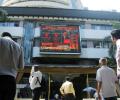
'There is a weak link between the economy and the stock market.'

The report said inflation is expected to remain below 5 per cent over the two years.

India's economy is showing signs of slowdown, with hi-frequency indicators like industrial output posting subdued growth and automobile sales touching historical lows.

Bulls might be on the rampage on Dalal Street but lofty valuations of the Indian equities present a reason for concern and the markets could perhaps witness up to 10 per cent correction, according to analysts. Benchmark indices have been on a record-breaking rally lately and August witnessed the stock market reaching many new highs. The BSE benchmark soared over 9 per cent last month.

The UK voted to leave the European Union after 43 years.
The sharp downward swing in market sentiment in the past six months has rendered stock valuations attractive. Here are some stocks experts say will deliver handsome returns.

There's no silver bullet to get rid of poverty, says Alok Sheel.

'They can shift to dynamic asset allocation funds to automatically rebalance their equity exposure.'

Despite near-term headwinds of rising input costs and the possibility of lower demand for products as Covid dented rural & urban India, and impacts both production & consumption, analysts remain bullish on stocks of fast moving consumer goods (FMCG) companies and expect the index to relatively outperform its peers in the second half of fiscal 2021-22 (FY22). In the past one year, prices of key commodities such as groundnut oil, mustard oil, Vanaspati, soya oil, sunflower oil and palm oil have shot up in the range of 20 per cent to 60 per cent, data show. The FMCG sector macros in this backdrop, according to analysts, have further deteriorated because of weakness in consumer demand and likely margin pressure due to elevated crude oil, palm oil and global food prices.

'When you need to revive the economy, when you need to revive aggregate demand, you cut taxes.' 'But what's this government doing?' 'It's increasing taxes for the middle class and the vast majority of the poor on fuel, which has a ratchet effect on most other products.'

Similarly, the wide-based 50-issue CNX Nifty of the NSE jumped 109.30 points, or 1.46 per cent, to end above 7,500-mark for the first time at 7,583.40.
However, a net amount of Rs 11,119 crore was withdrawn from the debt segment during the same period. This translated into a net investment of Rs 1,003 crore.

The next 12 months will be quite challenging marked by uncertain political events and evolving macroeconomic scenario

'This is a period of significant uncertainty, of unknown unknowns.'

The real benefits can be seen when prices stabilise, preferably at levels acceptable to both consumers and producers.

So far in 2019, India has been one of the highest recipients of foreign flows among Asian and Emerging Market (EM) economies

Low home loan rates by banks could put large players in an advantageous position over smaller non-bank players, believe analysts.

Tata Steel was the biggest gainer in the Sensex pack, rising 3.36 per cent, followed by Vedanta, Bajaj Finance, TCS, IndusInd Bank, Infosys, ONGC, Kotak Bank, HDFC Bank, HDFC, M&M and ITC.

The long-term growth perspective or potential for India is one of the highest in the Asia Pacific region.

Stretched valuations and slowdown in DII flows are some of the reasons why Goldman Sachs cut its India rating to 'market-weight'

Volatility is part and parcel of stock market.

The report further noted that inflation is expected to fall to 4.5 per cent by quarter ended March 2017.

'The market won't wait for earnings to recover.'
Amid sustained weakness across categories, the Indian stock market remained below the trillion-dollar mark for the third consecutive day today, as the total valuation of all listed companies slipped further to $944 billion.

Brent crude prices fell to $57 a barrel on Monday from $62 a barrel.

In the year to date, 61 PSUs have lost an average of 22 per cent, with five companies losing more than half their share value. The BSE PSU index is down 10.6 per cent.

The wait for the new iPhone is over as the tech giant Apple officially launched its new iPhone 13 and iPhone 13 Pro on September 14.

Subramanian was the Dennis Weatherstone Senior Fellow at the Peterson Institute for International Economics and Senior Fellow at the Centre for Global Development in the US before joining the ministry.

As the reform process is expected to gain further momentum, the Indian rupee will continue to outperform its Asian peers, which are likely to weaken further against the US dollar in 2015, says an HSBC report.

Government's food subsidy bill tends to rise in tandem with the MSP increase.

Many analysts find market expensive, even at current levels.

Check out some of the stocks that will react on the basis of their numbers in the near term.
 © 2026 Rediff.com - Advertise with us - Disclaimer - Privacy Policy - Sitemap - Feedback - About us - Terms of use - Grievances